Review by Mack Hassler
“This is how God created the heavens and earth ‘For Behold, I am creating a new heaven and earth.’” Isaiah 65:17
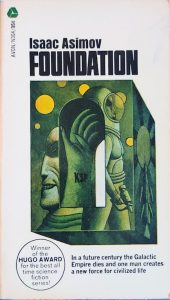
For twelve thousand years the Galactic Empire has ruled supreme. Now it is dying… only Hari Seldon, creator of the science of psychohistory, can see into the future. Seldon gathers the best minds in the Empire both scientists and scholars—and brings them to a bleak planet at the edge of the Galaxy to serve as a beacon of hope for future generations. He calls his sanctuary the Foundation.
Part of the opening of The Foundation Trilogy (Isaac Asimov,1951)
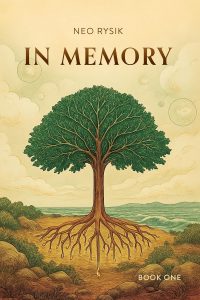
 The notes to this very interesting new novel, In Memory, tell us that the author has been trained in nuclear engineering and law and religion. I am told that his technical work was mostly at Michigan Tech in Houghton, where he lives. So he is now a bona fide Yooper working on a science fiction Trilogy (this is Book One) modeled on one of the masters of the genre who was no Yooper. Asimov once told me he never liked to leave New York City. That city of steel served him as the model for the central city of his Galactic Empire. The name Asimov gave Hari Selden’s home, where he invented the massive computer necessary for his science of Psychohistory, is one I will never forget: “Trantor.” It is one city that covers the entire planet,. So the planet has the name Trantor as well. On Trantor, no piece of real estate remains in its natural state. As the lyric in the musical Lizzie Borden, “You can’t chop your Mama up in Massachusetts.”Massachusetts is a far cry from New York.”
Nevertheless, Rysik’s novel has a cover photo of a deep-rooted large tree that one might see along the boulevard in Marquette out to Presque Isle with the waves of Lake Superior in the background. Rysik’s “memory board” is not limited to just copper wires and steel beams. Roots dig deep into our Earth and into our heads. I think Rysik’s machine is a human machine—maybe even artificial intelligence . In fact, Rysik claims in his endnotes that the story of Yohi was actually composed with the use of AI. So the Asimov story of Hari Seldon has long been dead (Asimov died in 1992); the story itself is now reincarnated by AI to live again.
 Rysik opens his storytelling about his “Memory Machine” in a way that nearly seems to be like teaching a child (the young boy is named Yohi—his grandfather had been a Polish Jew who was recruited by the Yiddishe Kampf, a Jewish combat organization) to read with hints of the old Jewish grandmother. As she teaches this young wunderkind who will engineer the Memory Machine, she fills him in on his family background: “We will need arks, Yohi. Not made of wood this time, but strong, adaptable. Sanctuaries strong enough that can last long enough for the flood of suffering to pass.” (p.9) The Ancient Hebrews hated oceans and bodies of deep water. So young Yohi has his project: to make a mac may be behind as a sanctuary (echoes of Asimov ) to outlast the floods of suffering our planet must weather in order to survive.
Later, Yohi will change his rhetoric and make his claims for the machine as being able to talk in the Ancient Angelic languages with all of God’s creatures, as well as the language of the rocks and the waves of the oceans as they vibrate and orchestrate across all of the creation of the New Heaven and the New Earth. These opening scenes with his Abbah illustrate the quantum leaps the boy Yohi must make in engineering. Recently, at my very liberal church, where anyone is welcome, whatever their sexual orientation is, we watched a documentary film titled “1946.” The point of the film was the political effects of a mistranslation in Saint Paul’s Greek of the terms for “homosexual” and for “same sex marriage.” We have seen that the cultural effects from these mistakes in the translating of the Greek have caused a flood of anger and of pain. Those difficulties in our politics could have been avoided or “reduced” at least if Yohi’s Memory Machine had been used.
I think it would be unfair in this short review to open up all the interconnected passageways in the Labyrinth of Yohi’s Memory Machine. He seems to me a genuine Hari Seldon . Asimov kept talking about the Sanctuary of his Foundation until just a year or two before his early death in 1992. Being a wunderkind is exhausting. I will say that even in this first volume of The Trilogy, Rysik claims we can prevent the collapse of the “New Earth” by paying attention (Listening to what the rocks, fields, and mountains are telling us in their languages). Yohi has been well trained with this version of artificial intelligence. We should look for the next two volumes of “Memory.” We shall see if the artificial intelligence used, indeed, can reincarnate Hari Seldon’s plan for saving our corner of the universe. In my own work on Asimov, I toyed with the idea that he had, in fact, in mind the thousand-year plan of National Socialism for the German Empire. We know that idea was thoroughly put behind us with the end of the Second World War [my arguments appeared in my award-winning book titled Readers Guide to Isaac Asimov (Starmont 1991), which won the Award for the best critical work on SF for 1991].I think AI can often give the impression of reincarnation, but history doesn’t repeat itself with the same regularity as artificial intelligence does. Nevertheless buy this book in order to see what Rysik thinks he is doing. His “Memory Machine” hangs on to Asimov a lot . I had a teacher in college who liked to gloss the word “depends” with its literal meaning “to hang from.” My teacher must have had a vision of AI. But like Asimov, the man is long dead now.
Finally, In Memory, is an interesting book that it’s auhor claims does use AI. But I prefer a writer who does his/her own research and documents it. Thus, in my opinion, a book on “psychohistory” in Asimov’s Trilogy ought to define what “psychohistory” is and reference some of the other published material on the topic. Rysik does neither of those jobs of definition or accounting for what others have said on the topic. Instead he lets his own “Memory Machine” do the writing for him. If I were teaching as I once did a creative writing class and Rysik submitted this novel for a grade, I would tell him to do it over again in his own voice – or at least make it a research paper if he insisted on fiction. As is, it is not a genre I recognize.
[Editor’s Note: UP Book Review requires advance disclosure of any texts written by AI prior to review submission. Those which are “discovered” later to be written by AI will be banned]
Review of In Memory, Book One. By Neo Rysik (published by www. DoratidPublishing.com. first edition 2026) 320 Pages, PBK, n,p.