Review by Deborah K Frontiera
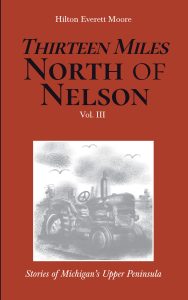 Once again, Hilton Everett Moore writes about those subjects people don’t want to talk about; the things that often happen to friends, family, and neighbors in Michigan’s Upper Peninsula (and in other places, too) more often than we care to admit. And, once again, he does it with brilliant writing that conveys the forgotten, marginalized, and castoff characters as people we might know. He tugs at our hearts, daring us to be more forgiving and less judgmental of others. And if readers say they don’t like the book, perhaps it’s because it makes them feel uncomfortable. Maybe they are not yet ready to accept the people they might know who have problems similar to those of Moore’s very believable characters.
Moore begins that theme right off the bat with “No Name Lake”, the story of a disbarred lawyer who is trying to find a new path, any path, in his life. He prefers to fish alone but finds himself talking to a young man he feels is invading his privacy at the lake. The subtle lesson: you don’t know the story of a person you first see as a derelict no-good, but you never know if that person could become a friend.
Then comes “Broken Bowl”. Calley is the owner of a “marginal” antique shop. “Her grandparents were like distant memories, much like the sepia photographs on a stairway wall.” (Pg. 28. “Calley understood she was ensnared in this web by her own choice and by her own design. So when her friend asked again, she just shrugged her shoulders and gave up trying to explain.” (Pg. 29) Then there’s Sam who “swirled the ice cubes like stones tumbling down the rapids of the nearby Sturgeon River. He knew he wasn’t a deep thinker but made no self-apologies for that. Like the current of the Sturgeon River, gouging out a bend where the elusive brook trout hid, he believed that most knowledge came from life itself and not from books.” (Pg. 32) Sam’s old army buddy comes to visit and ends up in the antique shop trying to find a gift for someone he knows. His eye settles on a “broken” bowl, and he criticizes the price on it. Calley, sensing there is more to the bowl than meets the eye, and also seeing that David cares nothing about it, refuses to sell it to him at any price. You go girl!
The symbolism of “The Woman at the Well” is self-explanatory. I loved this line from page 60: “This thought surprised her. It seemed almost mystical, and she was too pragmatic for that kind of stuff. She was grounded like an oak, its roots spread out for stability, firm, like having a hold on the earth that was not easily swayed by circumstances.”
“Clara” is a story of infidelity and forgiveness. Clara is a widow whose peace is shattered when she learns the truth about her dead husband’s health, his infidelity and other secrets. After the initial anger, she finds peace and freedom, and a dream for herself, And a connection to the “other” woman.
I learned a lot about rabbit hunting and beagles as hunting dogs while reading “Bunny Hunting” and the problems that may arise when taking one’s girlfriend out on a hunt. I found little hints of O’ Henry’s “The Gift of the Magi” in Pat and his girlfriend Lee Ann, and Bertha—Pat’s grandmother in this sometimes-humorous story.
Later, readers meet Bill Junior, a dog named after his owner, a young boy in a growing-up story who treasures an old, ruined rowboat—his place of peace and imagination, a black man from “downstate” who finds a son he never knew he had, and many more. There are surprise endings, too. Pay attention to the details in the title story, “Thirteen Miles North of Nelson”. You never know when you may need to remember some of those survival tips yourself.
I will close my review of Thirteen Miles North of Nelson, Vol. III by Hilton Everett Moore with one particular description of the U.P. tells all readers what it is that makes us leave the U.P. but ultimately come back to it because if you are from the U.P., you never quite get it out of your system. From the narrating character’s perspective in “The Gold Pin” page 115;
I find this land compelling. It draws me in despite its coarseness. Many of the rough denizens—are country intelligent, but rarely educated beyond high school. Family roots sink deep, intertwining in complex patterns that would confuse even a seasoned genealogist. Going to the cemetery is a frequent family event here, where quiet walks through moss covered tombstones seem like a natural event. I write, and I love all this and could never leave it for another place. I am planted here like an oak tree, a staunch reminder that place is not only important but a necessity.
Thirteen Miles North of Nelson, Vol. III
By Hilton Everett Moore
ISBN: 979-8-89656-123-1, Silver Mountain Press, 2026, Ret. $21.95 (PB)