Review by Mack Hassler
“It is interesting to contemplate a tangled bank, clothed with many plants of many kinds, with birds singing on the bushes, with various insects flitting about and with worms crawling through the damp earth, and to reflect that these elaborately constructed forms, so different from each other in so complex a manner have all been produced by laws acting around us. These laws as our planet makes its yearly orbit of our sun.”Charles Darwin, from the final paragraph, The Origin of the Species (1859).
“The cowboy painter Charlie Russell in a verse written in 1917 (the year of the book publication of A Princess of Mars) foresaw revival of the frontier ethos in literature:
‘The west is dead my Friend
But writers hold the seed
And what they sow
Will live and grow
Again to those who read.’Robert Crossley, Imagining Mars. A literary history (2011), his chapter on “Masculinist Fantasies,” p. 154.
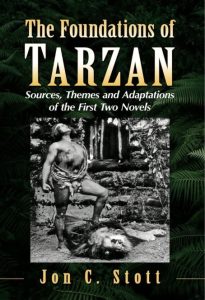 Jon C. Stott, like Darwin, is more interested in evidence and “the laws” of natural selection in his work as well as “the laws” of child raising in his discussion of the storytelling by Burroughs of Tarzan. But in my preparation for this review of The Foundations of Tarzan I discovered how “inventive” Burroughs was and how prone to ‘fantasizing” he was in his writing – not much interested in the evidence at all. So that topic is where I begin this review, and it will be of interest throughout since this is a review of literature and not a vetting of the evidence. Clearly, Burroughs read the market well both for stories about Apes and for stories about Mars. One blurb I found claims that he was the most read writer and storyteller of what Isaac Asimov calls “the golden age” of reading — our teenage years I read a lot when I was a teenager, but not much Burroughs. Now in late life, I find him fascinating and fun to read. Maybe I was an underdeveloped teenager. I liked history and loved the novels of Thomas Wolfe. I think I was saving my neuroses for later.
Stott confirms the popularity of Burroughs, and in his first chapter is very good on the early life of Burroughs. He had failed at nearly every job he had undertaken. But he liked to read the pulp magazines and perceived that he could write as well as stuff he saw there. He also was a great reader and owned many books about the opening up of”Darkest Africa”—books by Henry Stanley and the missionary Dr, Livingstone. Stott is very good at bibliographic listing. In fact, he lists t he Robert Crossley book I use here as my second epigraph—even with the citation of Crossley’s eighth chapter on “Masculinist Fantasies”. But Stott is much more interested in what Burroughs read than in speculating on his neurotic understandings. What Burroughs understood was that he could make money for his family and he understood, as the bibliographic detective work Stott does, shows that dark Africa was a hot topic. He began selling to the pulps.
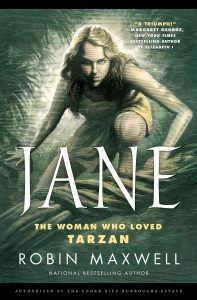 Both Burroughs and Stott are very good at perceiving the market value of constructing a piece of writing. Stott had made several years ago a long trek across the whole of the Upper Peninsula from his cabin just below the Bridge in Hemingway country to study local Ale brewing and he had interviewed several brewers on their home turf. This entrepreneurship and the interviews led to a book in this series Who would have thought opening a can of beer, once Stott and his wife reached their summer camp, would lead to a book? Here he interviews Robin Maxwell, who wrote the book Jane, The Woman who Loved Tarzan (2012) and covers the complex pulp history and film history of Tarzan in the 21st Century. And again his final chapter is very good bibliographically. Stott knows his material. The Foundations of Tarzan has many excellent and crisply sharp photos of Tarzan stuff including the Maxwell cover which makes Jane look like she was educated by the Mangani Apes. In Fact, we learn that Jane Porter is a trained paleoanthropoligist and part of a family of Cambridge scientists who chooses to live with her Mangani trained lover and teach him French. Clever literature is often more than just Freudian neurosis. So buy this book. I think now that it can go well with a good cold beer or ale.
Review of The Foundations of Tarzan: Sources, Themes and Adaptations of the First Two Novels, first edition 2026, by Jon C. Stott (McFarland Company, Inc; Box 611, Jefferson, NC 28640) 192 pages, PBK, $39.95.