Review by Mack Hassler
Tantae molis erat Romanem condere gentum “How hard it was to found the Race of Rome” Near the end of Book I, The Aeneid by Virgil (written about the time of Christ’s birth)
“ … they were now looking up at the branches of the ironwood, which appeared to be standing alone, not part of a grove.”
Ironwood: A Catalina Novel, by Michael Connelly (2026) p, 177.
While reviewing several of the history paperbacks by Michael S. Nyquist, I found time to read the latest pulp fiction by one of my favorite popular and very skillful storytellers: the second epigraph above. Catalina Island, which is about as far distant as one can get south and west from Longyear’s Upper Peninsula in our country, is home to a peculiar species of tree. The Ironwood has several trunks linked to one root system. The outlier in my epigraph seems to be a maverick standing alone. Both Nyquist’s approach to history and his topic, John Longyear, seem to me a little like the solitary Ironwood in Connelly.
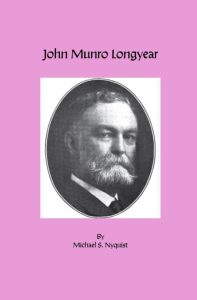 In this history, Nyquist uses more storytelling than in the first book I reviewed, which was mostly a listing or bibliography (a grove of related material). In history, we need lists; and I liked the first Nyquist book I reviewed. But I like even more storytelling. This brings me to the earlier epigraph above—the wonderfully compressed line by Virgil that, when one pronounces it in its two parts in both Latin and English, has the power of transition and emphasis.
A “mol” with the beginnings of science, for Virgil is a measure of weight. In our language, a “molecule” is a tiny bit of atomic weight. With “tantae” which means “many many” we get “very heavy” or “very hard” “erat” is the past tense of “to be” Therefore “How hard it was”. Then we have the infinitive “condere” and “How hard it was to found.” “Romanem” and “gentum” are genitive case of application. Therefore “How Hard it was to found the race of Rome.” It is fun to sort out the epigraphs.
My review needs to include the hard stories Nyquist tells. Aeneas’s journey takes him up and down and across the whole length of the Mediterranean, and it ends with him founding a new city-state to replace his lost Troy smack in the middle. The shape and midpoint of the Upper Peninsula looks a lot like the Mediterranean geographical shape with Marquette smack in the midpoint jutting out into the Big Lake exactly where Marquette and the Huron Mountain Club, founded by Longyear and Associates. So it’s a perfect fit for the storytelling Nyquist tells in this book.
Nyquist prints a great illustration of the newspaper advertisement of Longyear’s title company: “ Mathews & Longyear: Land Tax and Exploring Agency Front St: Marquette” (p. 35) “At the time of his death (May 1922) Longyear controlled over a million acres of land in Michigan, or nearly 10% of the entire Upper Peninsula….his estate said to be valued at $10 to $15 million.” (p 163) [the book is filled with headshots for most of the family] Longyear reminds me of Douglas Houghton, geographer, for whom I used the same Virgil epigraph in my review of the Young Adult biography by Deborah K Frontiera (posted here 1 January 26). The difference between these two young men, developers of mining and land development in 19th-century Michigan, is that Houghton gave his life, drowning with his dog off Eagle River as he searched for more copper. “…in 1923, Mary Longyear [wife of John Munro] established the Longyear Foundation; and after her passing her mansion served as the Christian Science Museum.” (p. 162)
That part of John Munro’s long life is narrated well by Nyquist in his chapter 23 titled “Further Funding for Mary Baker Eddy and the Church of Christ Scientist (p. 159-162). I particularly like the language work undertaken by the Longyears: “… Mary Longyear subsidized him(a Mr. Atkinson) in his work for a King James Bible to be created in Braille… .The project was completed five years later” (p. 161) —a far cry from the surveying of land and mining projects.
The well-narrated element in the long life of John Munro carries him into our own century and nearly up to modern times. He invested in a mining project called “Arctic Mining Company” in Norway and even started a small town in the region called “Longyearbyen.” Recruiting a manager for the distant project was difficult, but the company finally hired a Bostonian, Scott Turner.
I will end this review with a good job of storytelling by Nyquist that carries us into our century: “…Turner traveled to Boston aboard the ship Lusitania in January 1915 to consult with Longyear. Turner was headed back to Spitsbergen mines on the Lusitania when it was torpedoed on 7 May 1915, off the coast of Ireland, by a German submarine. Turner was among the 764 survivors of this attack, while 1,199 perished.” (p. 156) Nyquist is capable of storytelling. This is a fine book by him about an important individual in the developing history of Marquette and the Upper Peninsula.