Review by Jon C. Stott
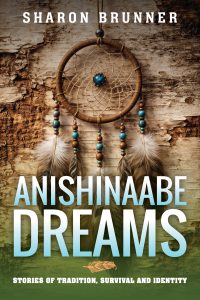 Sharon Brunner, a member of the Sault Ste Marie Tribe of Chippewa (Ojibwa) Indians, has been a social worker, professor, educational consultant, and author – and wise woman (and still is). A student of her people’s history and culture, she has participated in such traditional activities as the sweat lodge, pow wows, and sugar maple harvests. Members of her family create traditional crafts in the traditional manner that unites the natural and spiritual world. Her deep knowledge of and involvement in the Anishinaabe world are revealed throughout her most recent book: Anishinaabe Dreams: Stories of Tradition, Survival and Identity.
The word “Anishinaabe” means the original people and includes the Odawa, Ojibwa, and Potawatomi nations. The book deals with the three phases of their cultural and present history (with an emphasis on the Ojibwa): the legendary/mythic and pre-contact times, the destruction of the old life lived in harmony with the natural and spirit worlds by the invading Europeans, and the gradual rebirth of the beliefs and cultures these invaders sought to destroy.
Each of the twenty-four chapters includes a short essay and an accompanying poem. The topics range from the legend of the creation of the world to the still-practiced spring ritual of sugar bushing (maple sap harvesting). The former involved the actions of various animals to recreate the world after a great flood; the latter describes the communal activity honoring the maple trees’ gift to starving human beings. If the creation myth celebrates a beginning, the sugaring activity celebrates a rebirth of a tradition and of the annual rebirth of the world that the people share with other living beings. Such beliefs and practices as the vision quests of individuals, the honoring of individual clans within the larger culture, the communal events, and such crafts as the creation of birch bark canoes are all marks of a holistic way of life.
Reading the essays and poems written about the enduring qualities of a life in which the spiritual, natural, and human worlds live together, one frequently encounters such positive terms as “healing power,” “wisdom,” “love,” “balance and harmony,” and “respect.”
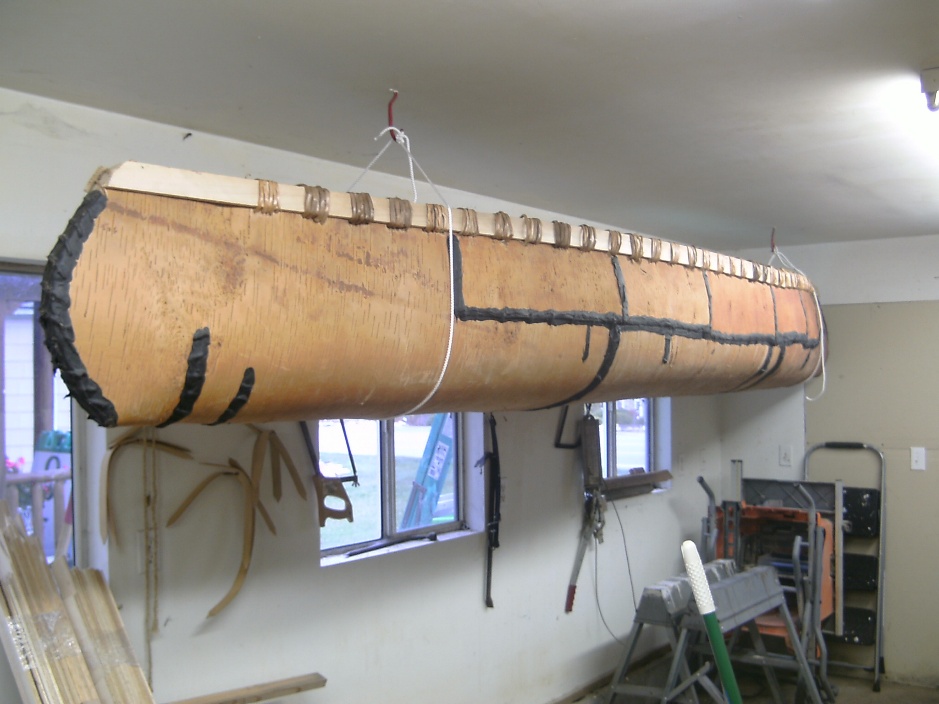
Canoe made by Sharon Brunner’s uncle Ron
The contrast between the pre-contact and the stark and brutal “customs” imposed by the invaders is best seen in the chapters in which Brunner discusses traditional native “schooling” and the Indian Residential schools. For the Anishinaabe, education involved all of the village; the children were taught, in addition to practical skills, “humility,” “bravery,” and “love.” Believing that taking the native children away from their communities was the surest way of destroying the old ways, the Indian boarding schools used physical, sexual, and emotional/spiritual abuse to control the children. Disease, malnutrition, fear, and lasting trauma were very frequent results. Brunner uses such words as “catastrophic,” “ravages,” “broken promises,” and “lies and exploitation” to describe the European invasion.
A first reading of Anishinaabe Dreams will be very enlightening for readers with limited knowledge of the traditional and modern lives of the Ojibwa, Odawa, and Potawatomi people. A second, slower reading – which is well worth the time — will open vistas of knowledge and wisdom, an experience that will be very enriching.
Jon C. Stott (Professor Emeritus of English, University of Alberta) is the author of Native Americans in Children’s Literature)
Sharon Brunner
Anishinaabe Dreams: Stories of Traditional, Survival and Identity
Ann Arbor, MI: Modern History Press, 2026