Review by Deborah K Frontiera
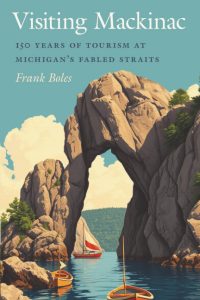 Visiting Mackinac: 150 Years of Tourism at Michigan’s Fabled Straits by Frank Boles is not a history of the community but a chronicle of the visitors to the island from the 1830s through 1990. What began as a military outpost, a hub for the fur trade, and then a fishing community had to redefine itself when fur and fishing industries declined. One could not call those earliest visitors “tourists,” but the journalists who traveled there in the 1830s and the reports they wrote for travel books or magazines began a long tradition of tourists going to the island.
The author states that the “first” of these tourists was Harriett Martineau in 1830:
“On July 5 the ship in which she was traveling stopped at the island to deliver a small quantity of cargo. The captain planned to quickly unload the cargo and resume his voyage, but the ship arrived near dusk and the person responsible for receiving the cargo insisted the shipment stay onboard until it could be more safely unloaded in the morning. … Taking advantage of the situation, Martineau made arrangements to go ashore at dawn. … The commander of Fort Mackinac gave her a brief tour … Her account of the visit, published in 1837 in her widely read Society in America, portrayed Mackinac Island as a place of mystical beauty.” (page 4)
Travel books were very popular in those days, so other writers followed. These travel writers reported on the beauty of the island, the clear air and the health benefits. These early visitors also wrote of the Native American population there—some complimentary and some stereotypical. But they also bought handmade artifacts.
“The incorporation of Indigenous products into tourism was usually done in a way that did not honor the culture and people who had created it. A description written by a member of a group of immigrants headed toward Wisconsin notes that, on their brief visit to Mackinac Island, among the first signs they saw was one painted in large letters reading ‘Injun Curiosities. ’ It was still there in 1848 when another visitor commented about it.” (page 14-15)
With this well-researched start and filled with interesting detail, the author continues through a timeline of chapters with some overlap: 1836-1861, 1870-1894, 1895-1930, 1929-1941, etc., ending in 1990. Some of the main ideas echo tourism in general. The rise of the middle class after the Civil War years resulted in more people having money to travel. The building of railroads and improved shipping made it easier to reach many destinations. But during much of the earlier days, Mackinac Island was not a “premier destination.” It took some creative marketing to accomplish that.
Along the road to “fame,” I learned some interesting facts. Fudge was not invented on Mackinac Island. In 1875, part of the island became the first National Park east of the Mississippi. Three railroads invested in building the Grand Hotel and then produced travel brochures describing it and the island to boost their businesses. That “magnificent porch” made up for an “uninspired” interior.
“The porch had an unparalleled view of the water. It was also an ideal place to promenade, a pastime Victorians took great delight in doing. … On some evenings, after a fine dinner, a formal dance was held. Even more than during the afternoon promenade, the evening dance was the place to see and be seen. Men wore formal attire and women appeared in their finest gowns.” (page 31)
The author also reports in depth on the many problems that plagued the island as a tourist destination. The army left the fort, so there was no one to administer the National Park. It became a State Park, but with no funding from Lansing. Enter politics and all the accompanying squabbles. How to get state money? How to attract more people to spend more money? Free enterprise and development vs. preservation of beauty and history … Politicians and greedy businessmen often don’t play nicely in the sandbox, and the intrusion of “illegal” liquor and gambling during the 1920s and 1930s kept places like the Grand Hotel afloat. Whether to allow electricity and telephones to have and not to have automobiles also became political arguments.
Also related in good detail were the problems of the depression years and World War II, both of which caused a decline in visitors. The Grand Hotel was actually sold for debt during that time. The park commission and the businesspeople differed over the issue of stressing quaintness and history as a “heritage center” and over-commercialization. In the years from 1941 – 1947, the rivalry between Park Commissioner Doyle and Woodfill, the new Grand Hotel owner, seemed a bit dragged out at times, but I found it amusing how two influential men could argue so vehemently over silly things. The following decade saw the “fight” between Doyle and Michigan Governor “Soapy” Williams—oh, the competing egos of “Big Whigs!” Then I thought, “Has anything changed since then? Not really.” There was also the worry that after “The Bridge” was completed, people would just drive on and ignore Mackinac Island.
The section of the book following Mackinac’s tourist history touched on the development of tourism in St. Ignace and Mackinaw City and how both struggled to be more than a way to get to Mackinac Island. Overall, while a few places did drag a bit, I learned a lot about the rise of tourism in general and especially on Mackinac Island, which was well-researched and interesting.
Visiting Mackinac: 150 Years of Tourism at Michigan’s Fabled Straits by Frank Boles
ISBN: 978-1-61186-551-6, Michigan State University Press, 2026