Review by Tyler R. Tichelaar
Sara Maurer’s debut novel, A Good Animal, perfectly reflects a writer following the advice of writing what you know, and what Maurer knows is something many of us will find unfamiliar and yet fascinating. In its barebone structure, the novel presents us with a fairly typical an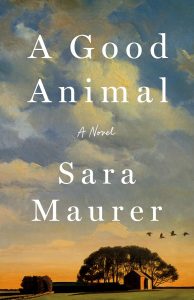 d even predictable story of a teenage boy and girl from two different worlds who fall in love but want different things. But embroidered all-around that unoriginal plot is the deepest realism about sheep farming in Upper Michigan. Maurer uses sheep farming as a metaphor, though that term hardly comes close to explaining her purposes of comparison, to enhance her storyline, and ultimately, provide the novel’s climax and resolution.
The main character and narrator, Everett, is a senior in high school in Sault Sainte Marie who has grown up on his family’s sheep farm with a younger brother, Jay, and little sister, Katie. He’s spent his life caring for sheep, being in 4-H, and showing and selling his sheep at fairs. The author herself has 4-H experience, which allows for the detailed but never boring descriptions of farm life. Everett’s best friend, Charlie, raises hogs. Charlie’s girlfriend, Kylie, first introduces Everett to Mary, a girl just moved to town, also a senior, whose father is in the Coast Guard. As a result, Mary has moved around her entire life without putting down roots anywhere. Not a fan of Sault Sainte Marie and its outlying area, Mary plans to go to college in California as soon as she graduates. From the start, Charlie finds Mary kind of uppity, but Everett is taken with her. Nor is Mary interested in Everett at first since she doesn’t plan to stay, but eventually, they begin seeing each other.
The novel’s romance is well-developed, but so much more in this novel is worth appreciating. I was especially impressed with Maurer’s ability to depict teenage boys in a realistic way. Charlie is rather obnoxious, the kind of best friend so many boys have who likes to embarrass them, put them down, and at the same time, is someone you can talk to. Charlie tries to dissuade Everett from being involved with Mary, but Everett isn’t listening. Despite being best friends, also typical, the two boys have a love-hate relationship that eventually leads to serious conflict and an epiphany for Everett that he is actually stronger than Charlie. That revelation may have been my favorite moment in the book because it made Everett realize how much he has been failing to acknowledge his own greatness. On a more subtle level, we are told Everett is in a remedial English class, yet as the narrator of the novel—the pseudo-author—we can only think he was far better at English than he knew.
Perhaps most impressive about the novel is that Maurer presents a deeply realistic—at times brutally so—portrait of life as a sheep farmer. This is no feel-good, pastoral, idyllic tale of shepherds and shepherdesses out of the pages of Sir Philip Sidney’s Arcadia. If anything, it is Thomas Hardy in the U.P. In Hardy’s novel, Far from the Madding Crowd, the main character, Gabriel, a sheep farmer, loses his flock of sheep when his dog goes crazy and drives them over the cliff. Maurer doesn’t shy away from that kind of tragedy and all the difficulties involved with raising sheep. As a case in point, Everett knows his little sister, Katie, is going to have a hard time at the fair when it comes time to sell her ewe. Everett knows from experience that little kids put all their effort into raising their sheep with hopes of winning a prize. They don’t think about what happens next—the sheep is sold for meat. When Katie has an emotional breakdown, Everett finds himself bidding on her sheep to save it. His family thinks him foolish, but he decides he will buy a ram and breed it with Katie’s ewe and start his own flock. I won’t give away what happens from there other than to say nothing goes as planned.

Sara Maurer
And yet everything isn’t a loss. When Everett and Mary find themselves in trouble, Everett’s knowledge of sheep ends up being the highly original solution to their problem. At other times, I felt like the sheep were a metaphor for the characters. The way the rams tend to fight for the ewes is not much different than how Charlie and Everett try to compete for girls’ affections with bravado and putting down the other.
Also worth mentioning, and perhaps the most deeply moving part of the book, is the relationship to the land and the sense of place. Everett can’t see himself living anywhere other than Sault Sainte Marie or doing anything else but raising sheep. Some might say he’s very focused, but others might find him sheltered and narrow-minded. Mary, who has moved around so much, finds him attractive precisely because he is so firmly grounded and attached to home. She’s never really had a home.
At first, I admit I was hesitant about reading this novel. While I love UP literature, I didn’t think I’d really care that much about the story of a sheep farmer. I was wrong. Farm stories are few among U.P. novels so far, often overlooked among all the mining and logging narratives, but Maurer has managed to carve out her own UP niche. Beyond that, she is a master of regionalism. A Good Animal belongs in the same category as Willa Cather’s O Pioneers for capturing a time, place, and way of life that would remain unfamiliar to most readers otherwise. Plus, it makes the reader think about their own decisions—past and current—and how they have repercussions. But it also affirms that, whatever happens, we can still make things right and try to be good animals.
A Good Animal: A Novel
By Sara Maurer
ISBN: 978-10250-38356-3 (hardcover)
ISBN: 978-1-250-38357-0 (ebook)
St. Martin’s Press
Release date 2026