Reviewer: Sharon Brunner
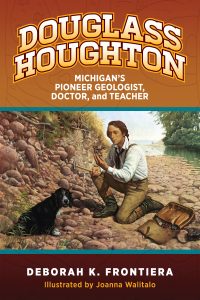 Deborah K. Frontiera’s book Douglass Houghton: Michigan’s Pioneer Geologist, Doctor and Teacher offers a portrayal of an academically high achiever and his discovery of potential resources of a brand new state. Michigan became a state in 1837. During Douglass’ earlier years, his parents, Judge Jacob and Lydia Houghton, valued learning and provided their children with a good education. Douglass pursued many areas of study, as demonstrated by the subtitle. He liked learning about medicine and science. As an adult, Douglass conducted surveys in the lower and upper peninsulas in Michigan during the 1830s and 1840s. As part of Douglass’ exploration endeavors, he traveled with Henry Rowe Schoolcraft. Their travel served geographical and geological purposes. Their first excursion involved finding the source of the Mississippi River, and later on, he surveyed and mapped Copper Harbor, at the tip of the Keweenaw Peninsula, a community in the Upper Peninsula of Michigan (U.P.). He also traveled to other towns in the U.P., such as Sault Ste. Marie while he worked as a geologist and sometimes as a physician. Frontiera provided a thorough overview of Houghton’s life and his accomplishments.
Schoolcraft could speak the native languages, so he convinced many of the indigenous to receive smallpox vaccinations when they came upon the indigenous while visiting the upper and lower peninsulas. Modern modes of refrigeration and freezing did not exist, so Douglass sought salt sources to help preserve food. Houghton also located important minerals and other resources. The U.P. became an important source for copper. Houghton and Schoolcraft brought many samples of rock, such as copper, back to Washington DC to provide legislators with samples. Douglass wore many hats, from serving as a medical doctor to becoming the first state geologist in Michigan and teaching at various educational institutions such as the University of Michigan. He traveled during the warmer months and taught during the late fall and winter months.
Some of the themes in the book were exploration, the importance of education, and humanitarianism. Douglass proved to be a conscientious and caring individual. He used his own money to help supplement his exploration activities beyond what the government paid him to make sure he accomplished what he wanted for the people who lived in Michigan. He traveled all over the lower peninsula to locate salt sources so the people could preserve their food and not have to rely on imports from other states. He did locate salt streams. He provided medical services for the indigenous and the rest of the population and only charged what his patients could pay. And often his medical services were free of charge. The state mourned after his untimely death in 1845 and wondered how much more he could have accomplished if not for that fateful storm.
The book that came to mind when reading this book was “Michigan’s Columbus: The Story of Douglass Houghton” by Steve Lehto. The name Houghton has been used for a county, a city, a lake, waterfalls, schools, and more. He discovered more than any explorer before him from salt springs to gypsum. He also served as the mayor of Detroit, in addition to his teaching and medical career. As a professor, he taught geology, mineralogy, and chemistry. His reports launched a rush to the copper country in the Upper Peninsula. A detailed account of Douglass Houghton’s geological reports was prepared by The Michigan Historical Commission along with the State Department of History and Archives Department. He was listed on this report as “First State Geologist of Michigan: 1837-1845.” The report was organized on May 28th, 1913. A detailed report of his findings was provided in this document. A documentary that came to mind was “Winona: A Copper Mining Ghost Town” by Dr. Michael Loukinen. It focused on the decline of Copper Country mining communities. The video explained Douglass Houghton’s life and his geological work.
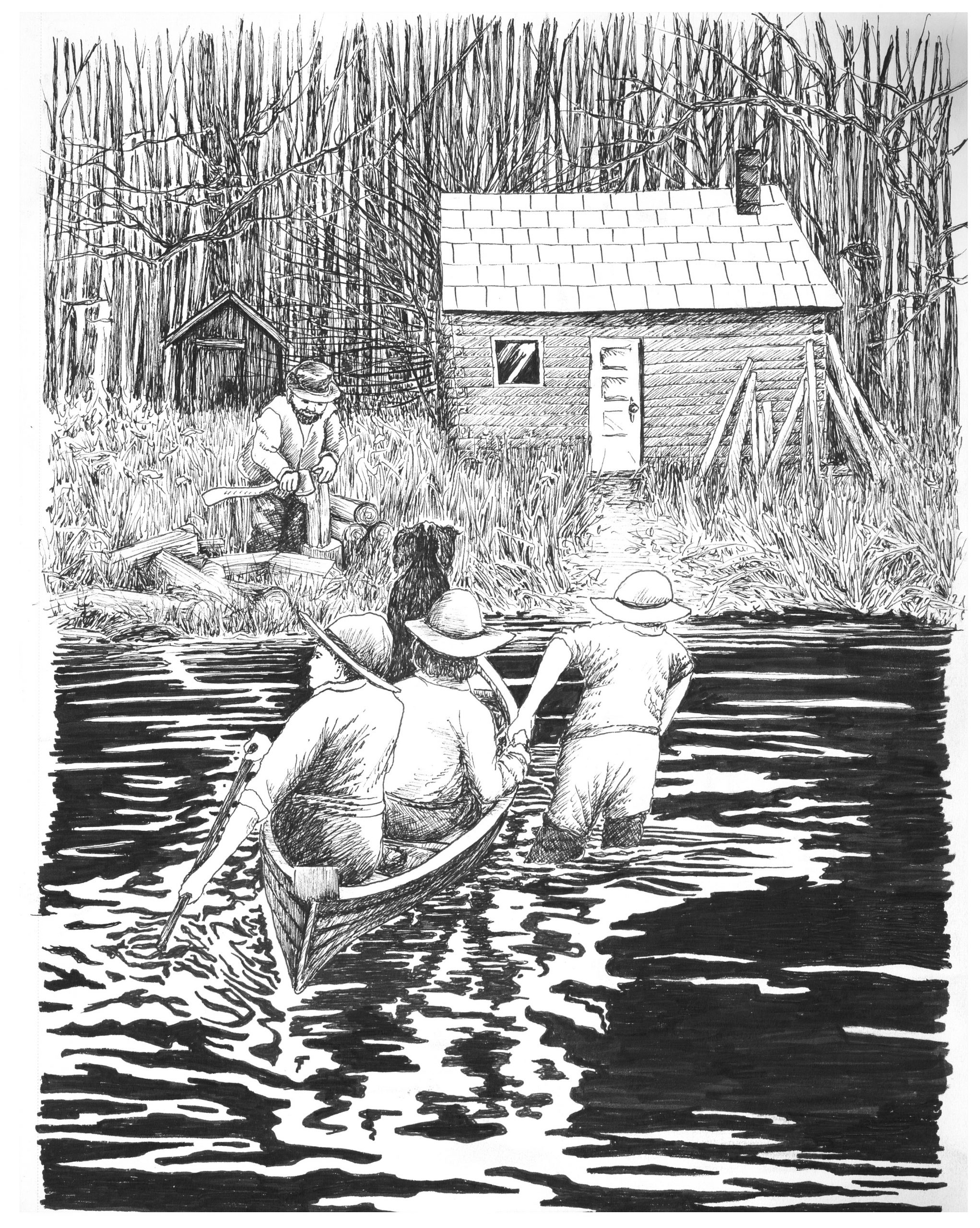
Houghton and explorers arrive at a trading post (Illus. by J. Walitalo)
My feelings differ about Henry Rowe Schoolcraft and when Michigan became a state. The 1836 Treaty of Washington made a big difference in the lives of many of Michigan’s native population. Schoolcraft filled an important part concerning the implementation of the treaty. He served as the Indian agent. The Odawa and Ojibwa tribes lost over thirteen million acres of land because of the treaty. The Euro-American settlers grabbed much of the land that was taken from them, and the indigenous people were pushed onto smaller plots of land, often referred to as reservations. What made matters worse was that Schoolcraft was married to a woman who was probably referred to as metis, she was half-Ojibwe and half-Scottish descent. Schoolcraft made sure the half-bloods received more benefits from the treaty than the full-blood Ojibwe and Odawa. Michigan did become a state as a result of this treaty. I am a member of the Sault Ste. Marie Tribe of Chippewa Indians, and I am aware that our legal department has continued to fight for tribal rights as described in the treaties that were put into place in Michigan between the federal government and the indigenous people.
I recommend Douglass Houghton: Michigan’s Pioneer Geologist, Doctor and Teacher for its historical facts about Douglass Houghton, because of its potential to provide valuable information for upper elementary/middle school/high school Michigan history courses, and for its historical facts about Michigan’s history during the 1830s and 1840s. Frontiera gave detailed information about Douglass Houghton’s life as a child, when he attended school, and when he was an adult and served as a physician, geologist, and educator. All his roles appeared to be of utmost importance to Houghton. He figured out the needs of Michigan’s population and sought to address those needs such as the salt deposits and copper. Frontiera provided additional historical data at the end of each chapter that covered what was happening in the U.S. during the same time. She offered suggestions for writing projects, questions for discussion, and projects to promote thinking and further learning. It’s a great book to provide children of middle school age and older an opportunity to learn about important aspects of Michigan’s history. Frontiera immersed the reader in the life and times of Douglass Houghton, one of Michigan’s outstanding statesmen, in an interesting and informative manner.
Title: Douglass Houghton: Michigan’s Pioneer Geologist, Doctor, and Teacher
Author: Deborah K. Frontiera