Reviewer: Sharon Brunner
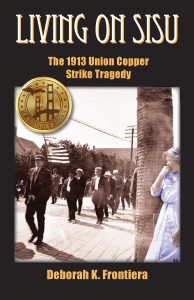 Deborah K. Frontiera’s Living on Sisu: The 1913 Union Copper Strike Tragedy offers a candid view of a violent strike against the mining companies in Houghton and Keweenaw counties of Michigan’s Upper Peninsula (U.P.) Twelve-year-old Emma Niemi narrated the story about her family’s participation in the strike and what else happened during that fateful year of 1913 in Calumet. Other characters in the book were Emma’s parents, her siblings, Katri, Jenni, Mattii, and Jaako; Juhani Hakala, a boarder at the Niemi house; MacNaughton, general manager of the mines; and Big Annie, one of the leaders of the strike. The story took place predominantly in Calumet, a community in the U.P. The term in the title “sisu” is a Finnish term meaning stoic determination, bravery, and persistence of purpose. It also means inner strength, action-oriented and cultural identity for the Finnish people. When Emma’s family was going to face a loss of income as a result of the strike, everyone in her family worked together to take care of their needs. The year 1913 was a tumultuous time in Calumet, many lives were lost, and many people’s lives were in danger.
Some of the main themes in this book were determination and violence. Emma’s father and mother, along with other people such as Big Annie, marched daily to support the strike. Emma was determined to help her family financially. She ended up working at Mr. Edward’s home five days a week and at his store on Saturdays. She attended school at night. Mr. Edward was asked how he could remain so calm when his customers were complaining about the strike and he replied that he really did not know the entire story, so he just listened. He was destined to keep his customers and gave them a place to vent their feelings. Regarding the theme of violence, Calumet represented a war zone in 1913. The strike started with strikers attacking men who wanted to go to work. The Michigan National Guard was deployed to Calumet. Emma and her sister heard gunshots during the night. Two men were gunned down when they walked in an alley. The sheriff opened fire with multiple deputies on a home. A young mother had to run with her baby, her baby’s face was marked with gunpowder.
Another theme that surfaced was capitalism. The strike demands were $3.00 per day for tram workers, $3.50 for miners and an 8-hour day. Other mine owners in outside areas from Calumet agreed to these terms. MacNaughton refused to give in to the demands and to accept the union. Meanwhile, the workers were living in basic homes without indoor plumbing and electricity. While the mine owners lived in what would have been considered luxury to the workers. Emma had a taste of such a life when she lived at Mr. Edward’s home. He owned the store where she worked. However, Mr. Edward’s home was not as nice as the mine owners’ homes. One of the common complaints was the one-man drills that were dangerous to operate. It was cheaper to use those drills without consideration for the men’s safety. Capitalism has raised its ugly head throughout the history of this country.
When reading this book, the book The Women of the Copper Country by Mary Doria Russell came to mind. It was a historical novel based on the true story of Annie Clements (Big Annie). She led the 1913-1914 miners’ strike in Calumet, Michigan. She earned a nickname of “America’s Joan of Arc.” Annie organized the Women’s Auxiliary to support striking miners who faced challenges such as poverty and fought for justice for her community. A 2013 documentary that came to mind was “Red Metal: The Copper Country Strike of 1913” by Jonathan Silvers. It explored the labor conflict between organized workers and corporate mine owners in Michigan’s Upper Peninsula. The documentary covered the hopeful beginnings to its tragic end.
The content of this book relates to my personal life. I had to work hard most of my childhood. My family owned a general store and gas station. My sister and I had to help in the store by waiting on customers and stocking shelves. Dating myself, but I had to count change the hard way. I had to pump gasoline during my junior high years. It was not a self-serve gas station. I had to check the oil and wash the windshield of each car. When I was eight, my mother had another daughter and I helped with her care like Emma’s friend.
I recommend Living on Sisu: The 1913 Union Copper Strike Tragedy for its detailed historical data, because of its young people who were filled with hope and fears in the wake of traumatic historical events, and for its admirable way in which Emma’s family lived on sisu. The book was filled with historical facts such as how the Finnish people were treated, the various ethnic groups who lived in Calumet at the time, information about the strike, and the living conditions of the people who worked in the mines. Emma was more than happy to do her part to help pay the rent for her family’s home by working for Mr. Edward. She appreciated the good things that happened during the strike. Emma enjoyed staying at the Edward home. She was fed well and she appreciated the indoor plumbing and electricity. Mattii, Emma’s brother, worked on a farm during the summer months to help provide for his family during the winter months. The children did not appear to look at the hard work as a problem but as an honorable duty. Frontiera brought to life in a delightful and informative manner how a family lived on sisu through their love and dedication to their family and community.
Title: Living on Sisu: The 1913 Union Copper Strike Tragedy
Author: Deborah K. Frontiera