Reviewer: Sharon Brunner
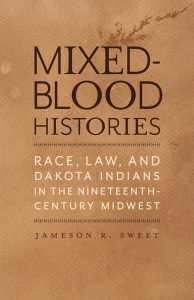
Jameson R. Sweet’s Mixed-Blood Histories: Race, Law, And Dakota Indians in the Nineteenth-Century Midwest delineated the legal and economic ramifications of the intermarriages between Euro-Americans and American Indians. The book took place in the Midwest which included the following states: Illinois, Indiana, Michigan, Ohio, Wisconsin, Minnesota, Iowa, Missouri, Kansas, Nebraska, North Dakota, and South Dakota. These states were often called the nation’s heartland and known for their diverse economy, agriculture and manufacturing. Sweet covered various wars: the Seven Years War, the Revolutionary War and the War of 1812 and all the areas including the Midwest these wars were fought in. The main characters described in this book included various Dakota tribes and other tribes such as the Odawa and Ojibwe tribes and the distinctive mixed-ancestry families of the Dorions and Laidlaws. The Dorions were the oldest of the mixed-ancestry families and they were interestingly involved in the Lewis and Clark expedition. They worked extensively in the fur trade. Lewis and Clark traded with the Dakotas which in turn cleared the path for other traders. The indigenous kinship system and the necessity of the mixed-ancestry Indian families aided in negotiations and diplomacy between the American Indians and colonial powers.
Treaties between the American Indians and Euro-Americans definitely played a role in the legal and economic complications of the intermarriages. Treaties with the Indian people were negotiated by the President of the United States and were binding when approved by the Indians and two-thirds of the U.S. Senate. Many tribal people felt they had no choice but to give in to the U. S. government. The greatest number of treaties were arranged between 1815 and 1860, during the prominent westward expansion when approximately 270 treaties were ratified. Almost 100 treaties specifically addressed boundaries between a tribe and the United States. Two tribes, the Potawatomi and Chippewa, negotiated 42 treaties for each of the tribes, which was more than any other tribes. Not all of the 574 federally recognized tribes established treaties with the federal government. The treaties were in place until the grass stops growing.
Sweet explained the definition of American Indians who were granted land as a result of the treaties, especially half-breeds or mixed-ancestry. Some legal authorities believed full-blooded American Indians could not be civilized. Sometimes intermarriages created legal dilemmas for white Americans. Bottom line for most legal actions taken against American Indians was the goal of assimilation. A multitude of government officials believed the mixed-ancestry families would influence the full-blooded American Indians to turn their attention to agricultural and mechanical pursuits and break away from their original focus of hunting, fishing and living a nomadic lifestyle.
An interesting tidbit about another way mixed-ancestry materialized was mentioned in this book, which was nonconsensual enslavement. “Father de la Morinee baptized a three-year-old child in 1747 at Mackinac, Michigan, the son of Charles Chevalier and a Sioux slave” (Sweet, 2025, page 26, para. 2). Sweet told about how Brush Rushforth found instances of enslaved Dakota people since the 1700s.
Sweet dedicated a chapter to the U.S.- Dakota War of 1862 in which President Lincoln played a major role. Lincoln has demonstrated his lack of respect for the American Indians on several occasions. During the Emancipation Proclamation, many American Indians were enslaved in the western states such as California. He administered the largest mass execution in U.S. history on December 26, 1862 when 38 Dakota men were hanged in Mankato, Minnesota for their role in the U.S.-Dakota War. The war occurred because the Dakota people were desperate and starving because of the government’s lack of follow-through on treaty promises.
Two of the themes in the book were kinship networks and tribal identity. I can personally relate to both themes. I have been called a sister by other tribal members. It is the belief of many American Indians that everyone is related. The four standard colors of white, red, yellow and black represent brothers and sisters, a kinship network. Kinship ties through marriage proved to be extremely valuable concerning the fur trade network between the 1600 and 1800s. Tribal identity was another source of contention. The Sault Ste. Marie Tribe of Chippewa Indians, of which I am a member of, has no blood quantum requirement concerning membership. Blood quantum requirements exist with the determination of who qualified for the Indian Tuition Waiver and who can belong to specific tribes. As mentioned in this book, mixed-ancestry American Indians met a disturbing realization that they did not fit in any group, with their full-blooded people or with Euro-Americans. Other ethnic groups have not been defined by their blood quantum.
The book that was related most to this text for me was the 1933 Land of the Spotted Eagle by Luther Standing Bear. In this book, the author summed up the Lakota and Dakota attitude toward women and mothers. During the fur trading days, primarily the French married tribal women which signed, sealed and delivered diplomacy between the indigenous and colonial powers. My ancestry consisted of this union which included a French Fur trader by the name of Isaac LaVake who married an Ojibwe maiden by the name of Ozawa Amik (Yellow Beaver). It comes down to the Indian women who married the European men as far as the materialization of the mixed-blood history. The movie that came to mind was the 1998 “Smoke Signals” movie based on a Sherman Alexie book “Lone Ranger and Tonto Fistfight in Heaven” (1993). The movie was a coming-of-age comedy-drama. The main characters struggled with their tribal identity while living on a reservation.
I recommend Mixed-Blood Histories: Race, Law, And Dakota Indians in the Nineteenth-Century Midwest for its specific families who were heavily involved in the mixed-blood histories, because of its definition of the vital role of American Indian women in the history of this country, for its importance placed on kinship, and for its portrayal of everyday struggles American Indians have faced concerning their identity. Sweet covered the role of the Dorion family and how they made an impact on the history of this country from the Lewis and Clark expedition to their role as interpreters for the fur trading industry. Without the American Indian women, the mixed-blood histories would not exist. Kinship played a vital role in many ways from securing relationships between the indigenous and the fur traders to the provision of land allotments for the mixed-ancestry people. American Indian people encountered many problems concerning their identity. The boarding school legislation caused identity confusion along with the concept of blood quantum. I am also a member of the Odawa tribe, but can not prove my lineage because the records were burned in a fire. Sweet brought to life in a colorful and descriptive manner the struggles many American Indians must face due to their mixed-blood histories.
Title; Mixed-Blood Histories: Race, Law, And Dakota Indians in the Nineteenth-Century Midwest
Author: Jameson R. Sweet