Review by Mack Hassler
Tantae molis erat Romanem condere gentum
“How hard it was to found the race of Rome”
Near the end of Book I, Vergil The Aeneid, written close to Christ’s birth
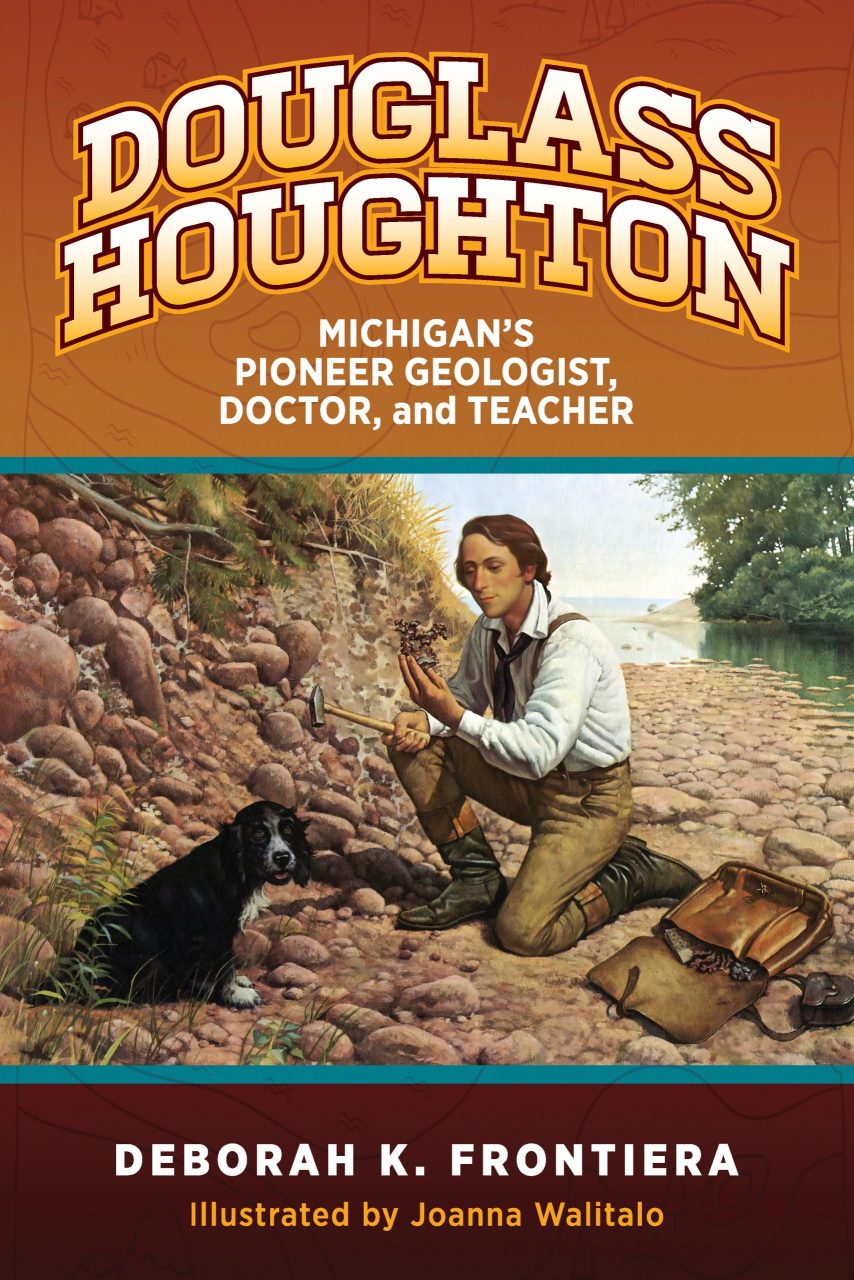 I love the interplay in this epigraph between the language play in ancient thought given to us Humans by God once the Tower of Babel had been destroyed, on the one hand, and the need to train young people to honor the pioneering efforts to create and establish new political entities such as the Roman Empire, later to become the seedbed of the Church as well, and the new culture in our beloved Upper Peninsula. Writing and thinking nearly at the time as Vergil the poet, Lucretius the science thinker had a word for what even at that early time they suspected properly were the building blocks of Nature—molis—our word “molecule.” Clever poet Vergil invents the phrase “so many hards” or “very hard” or “how hard” Deborah Frontiera is an all-purpose writer, editor, and a great contributor to the mission of the UPPAA, and so she seems to me to be the ideal person to have researched and written this first book in an important new series for our young readers. Knowledge about figures such as Houghton, who are clearly the “founding fathers” of our developing regional culture. Frontiera has been teaching school at this level for more than thirty years and so knows and loves her audience well. She is also an experienced writer. One of the first books I reviewed for the UPPAA (and I have been fortunate to have reviewed many) was her clever version of an epic storytelling modeled on Vergil’s Aeneid in which the “pioneers” are all tiny ants. This epic, modeled on Vergil with some irony was originally published in 2004 as volume one of The Chronicles of Henry Roach-Dairier “how hard it is to create a new culture in the Upper Peninsula.” She has also done a well-researched “History” of the parish Church in the town of Lake Linden where she grew up. She has been writing a long time and has mastered a variety of genres in her work.
Here she writes smoothly and carefully for her young audience, and she has done considerable research, traveling to consult archives in upstate New York and in Houghton’s hometown of Fredonia Further, her illustrator has produced maps and charts as well as attractive line drawings of the tragic death of Houghton on Lake Superior as he was caught in a violent storm while gathering geologic data and of his boyhood and young friends back in upstate New York. I think if I were still in 6th grade, I would eagerly go through this book. Frontiera captures her target audience. She is clear and very effective in describing the love of books and of learning and of human values that Houghton had as a young man. His parents turned a part of their home in Fredonia into a school called Fredonia Academy.
“Douglass became an outstanding student. Teachers and fellow students liked him and considered him a leader. He learned more than science, math, and Latin during his early life. He experienced how his parents loved and cared for him and his brothers and sisters. He saw their beliefs in action….Throughout his own life, Douglass lived these ideals as well.” (p5)
The key ideas in his life are not shortchanged. She says early in the book that from the time he was a young boy in Fredonia, New York he always could be seen with a book, and as soon as he could he went east to Troy, New York to study at the newly-founded Rensselaer School of Engineering (now RPI University). In 1830, the city of Detroit planned to hire someone to give talks during the long winter months, and they sent a representative to Troy and Rensselaer to find someone by consulting an expert on teaching there. The man from Detroit explained to the expert that what they wanted was a person who could give talks on “…chemistry (the science of chemicals and how they react), botany (the study of plants), and geology (the science of rocks and landforms)…” (p 11) The expert on teaching recommended Houghton. The Detroit representative was not sure. Houghton was only 20 years old and a small man—five and a half feet tall. But when he got to Detroit, he did an outstanding job and was well-liked. In fact, he impressed Henry Rowe Schoolcraft, who had been exploring Michigan’s Upper Peninsula with Lewis Cass (Governor of the Michigan Territory) for many years and who was, also, an ethnographer; and Schoolcraft invited Houghton to join his expedition to find the source of the Mississippi River.
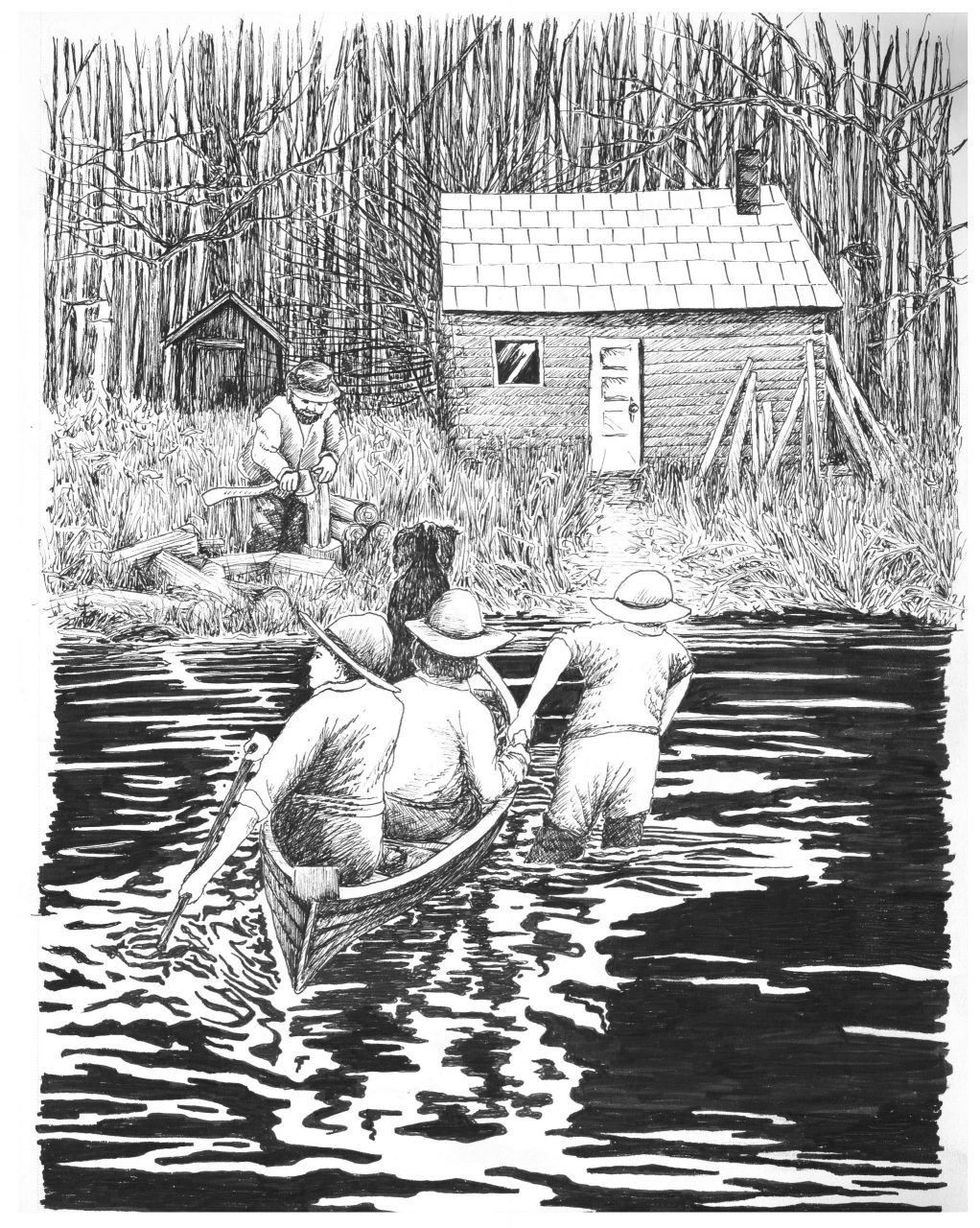
Fig. 6: Artist’s conception of what Douglass and his friends may
have looked like during the 1837 survey (J. Walitalo).
So, Houghton “left Detroit on June 5, 1831, to join Schoolcraft.” (p. 19) Since he had had medical training back in Fredonia, he was doubly valuable for Schoolcraft. He could vaccinate the Native Americans against the dreaded smallpox once Schoolcraft had persuaded them. On this expedition, also, Houghton made his important discovery of deposits of copper as he chipped at rocks near Copper Harbor. Once full statehood was granted Michigan in January of 1837, legislators easily named Houghton as the First State Geologist. Hi job was to explore the whole state to find out what resources were present “…so that people could begin to develop those resources.” (p. 32) A nicely-designed and clear chart of the five (5) survey routes is printed on the inside front cover of the book. Most of the field notes from these surveys were lost in the tragic drowning of this brilliant young scientist in October 1845.
Frontiera narrates this final event just as clearly and effectively. Houghton is in a boat heading for Eagle River in order to catch a larger vessel to head across the top of the Keweenaw and down lake to the Sault area. It is October, bad time to be out on the Big Lake. His rowers in the boat suggest they come ashore on a sandy beach while they can. Houghton is in the stern steering and says “no”. He wants to make it to Eagle River to catch his ride down lake. He takes a chance, one too many. A “rogue wave” capsizes them. As usual, Houghton has his dog Meeme in the boat with them. The dog is washed ashore and survives, ending up back home in Fredonia. Houghton’s body is found the following spring. The several other survivors swear to and sign a document that he was lost. His wife eventually remarries another man to help her raise their children. A large stone monument is erected in his honor and placed near Eagle River. All his field notes on his last survey trip are lost. He had taken a chance late in the season on the Lake and lost.
I love this genre and mode of storytelling. I guess I must be a kid at heart. Years ago, I read Johnny Tremain by Ester Forbes—about a young person who wanted to rid the Colonies of the British and died as one of the Minutemen along the road to Lexington. Johnny was convinced that “A Man shall stand up” against authority, and it cost him his life. I have never forgotten that story. It has had a huge influence on my life. The narrative flow as with Houghton was so similar. What he stood for killed him. But he stood up. Frontiera and her publisher tell and illustrate well the “standing up”. I think the book will influence young readers to emulate such dedication. We can only hope for more such important stories in the series – on Cass, on Schoolcraft, on Longfellow, on James Oliver Curwood.
Douglas Houghton: Michigan’s Pioneer Geologist, Doctor, and Teacher, by Deborah K. Frontiera, Illustrated by Joanna Walltalo (first book in a series about Pioneers in the History of the UP intended for upper elementary/ middle school/ and high school students published by Modern History Press, Ann Arbor, MI 48105), 91 pages, pbk $19.95.