Review by Mack Hassler
“That is why it was called Babel— because the Lord confused the language of the whole world” Genesis 11:9
 I think I will always, in a way, be thankful that God’s new creation of mankind in the Garden was a failed experiment. Adam and Eve and their children needed to be forced out of the East Gate and into the wider world of Eden once they aspired to be Gods themselves. This anogance continued when their descendants schemed to build a Tower high enough to master the one Angelic language that all God’s creatures spoke then and that they had spoken back in the Garden. So the Lord intervened to confuse that language and thus, as a side effect, allowed for the tones and shapes that we call poetry Angelic language is the rhapsody of all the choirs of the Angels. Human poetry is the polyphony of multiple forms and tones. As usual, we are the beneficiaries of God having to change his plans.
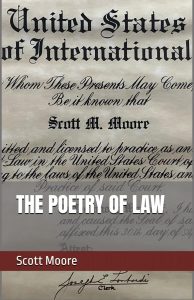
The Poetry of Law, a tidy and small booklet designed and written with only 25 numbered examples of varieties of “law ” poems, seems to me a very late example or product of language form as well as an unusual topic that fascinates me to review. In some ways, most of the work of John Milton, much of it blank verse poetry, can be labeled “political “or law writing. Except for its small and compact size, one might even say that this small booklet is “The Poetry of the Elephant.” It is that unusual or that much of an elephant in the room for a reviewer. It does not look nor feel like most poetry I have studied. No fleurs-de-lis, no tulips, no trees. A good place to begin is with the cover design, which Moore himself is responsible for. He lays flat the basic legal document of our nation “The Preamble of The Constitution of the United States with the law phrase “Be It known ” that Scott M. Moore ( his full name ) is a poet. The whole image on the boards is cast in a steely grey color like a Soviet parade of battle armor or German Panzer tanks as we saw them landing at the Normandy beaches. One of his poems is about a veteran of the Normandy landing, whose case appeared in circuit court where the presiding judge was Sonja Sotomayor, now a Supreme Court Justice. This is heavy, armor-coated writing and hardly lily- coated love poems by Rosetti or Browning or Swinburne. I like both types of work. Each of his 25 examples is more or less free verse–no sign of a sonnet nor any other formal stanza.
Maybe Moore can be so versatile because he is a Yooper. And he has represented many Ojibwa clients. That brings a very different language, of course, and Moore can handle the native American ritualistic song and dance as well. The medicine wheel turns. The medicine wheel has a variety of colors. So much depends for these ancient peoples on the courts of law. A judge asks “What is the difference between a tribe and a nation?” A wrong answer can lead to a smaller portion of land–less than a section. These peoples had possessed the whole continent at the start from sea to shining sea. Now, as the wheel turns and turns, they own less and less.
Moore is also a pilot. He flies with other private pilots in small planes. The electrical language coming through their headsets with its crackle and buzz, is also a language . This time with good illustrations from thirty thousand feet or more altitude . And the “crabwalk” as they move the stick just a tad to line up for landing straight into the runway. The crosswinds come off Long Island Sound as they align for landing in Manhattan. Moore has a big lawyer job now in the big City, where the early politicians had to journey from Detroit to prove they could win votes out East and go back to establish the Union League Clubs to hold the fragile Union together. For Moore, it is a journey from the Far North, but this time in his small plane with the planet turning beneath him and “crabbing the stick to fight the crosswinds and approach straight in and land his big job in the East. This is the language of the flyer, with its crackle and hum. I like these sections in the book–it is a language! hat neither Dante nor Milton nor Longfellow ever knew. Further. I think closer to the native American spinning Medicine Wheel, and more importantly, because as we admire the Native American with his chanting and weaving, we were robbing him with the Law
At the very end, Moore is on a commercial flight into Grand Rapids on law business, sitting next to a Black man with the same name as his. The stewardess leans in and asks his seatmate, “Mr. Moore?” He makes a nice, smaller poem about the difference of an “o” in the surname comes near the back of the book:
“I got my name from my Great Grandfather in Barbados.”
“Ah… ” the other nodded, understanding the British Slavery Colony significance “I got my name from my ancestors in Scotland.”
The other nodded, understanding the British Exile to Slavery Colony significance” p. 70
I think it is a nice way to conclude a book that deals with the variety of language use we can have and call them all poetry. Get this little book, The Poetry of Law and explore what can be done, what we might be able to do with the expressive language the Lord has given us, all of which we call poems.
The Poetry of Law, by Scott Moore, cover design by Scott Moore (a Scott M Moore poetry book, June 2025, self-published , Columbia, SC) 78 pages, hardcover n.p.