Review by Mack Hassler
“Well, I could have loved you better
Didn’t mean to be unkind
You know that was the last thing on my mind”
Tom Paxton (1964) reprinted by permission“But for Adam there was not found a Helper fit for him” Genesis 2:21
“If you build it, he will come” (Field of Dreams)
 With Kevin Costner as “Ray” who cuts his cornfield in Iowa to build a baseball diamond and meets his dead Dad there in the end and makes much more money than he would in corn since crowds miss baseball from the old days of the 1\venties. And with James Earl as the writer Terence Mann, who will stay and write up the baseball ghosts as well as Ray’s Dad (Jones is the Hertzel of her ghostly ideas) Field of Dreams (1989)
My late wife was part of a young folk-singing group at the University of Oklahoma in Norman when Tom Paxton was just beginning to perform in the mid-sixties. Sue passed away in 2022; our daughter Shelly still plays the keyboard and guitar and sings with a rock and roll group that writes and performs songs like “The Last Thing on my mind.”
I found it rather ghostly and mysterious to discover these lyrics near the end of this wonderful non-fiction memoir Ghosts of Fourth Street by Laurie Hertzel. It is as though her father may have done some of his graduate work in the wonderful English Department at Norman, Oklahoma. I should probably not continue reviewing here; it seems almost like writing about family. But I love the genre so much of non-fiction Memoir, what Hertzel herself now teaches in a low-residency MFA program and love to write about the two other epigraphs here from the story of God’s work in the project narrated in Genesis. Laurie Hertzel has won awards for her non fiction work; but like her Dad (and like Ray’s Dad in the Costner film) she seems to move from one teaching job to another non-tenured job -“looking for work” ( see below). It seems to refer to all of our efforts to make sense in our creative or generative work.
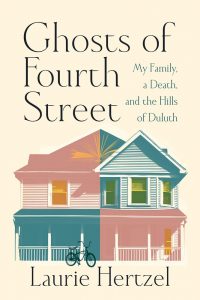
The title by Hertzel is very accurate. This is very much a ghostly piece of writing. Parts of the text have appeared as independent essays in good places, and the Press at the University produces a handsome and beautiful small hardcover that compares nicely with the several, larger and well-designed and well-illustrated volumes that I have reviewed here from Minnesota.
Just before beginning to read Hertzel, my daughter and I went to the theater to see the new release The Bride (2026), a masterful retelling of the Frankenstein story roughly a century following its original presentation to the public. “Frank” over the years evolves into a Satanic character more resembling a 1936 Chicago mobster killer of the Jazz Age with some of the trappings we are used to seeing in Scott Fitzgerald’s Gatsby and his other Jazz Age works with “Zelda” as the very beat up “Bride.” My strong feeling was that the stitched-together “Satan” monster that God chooses or allows to be made, just as God allows “woman” to be made as well as sexual generation to be “made” (the sex scenes in Bride are brutal and effective) since God’s original creation for Adam’s companion had not worked.
Storytelling, and this includes Memoir, may always require modification. If one approach does not work, try another approach. This is the “trial and error” that Darwin talks about in the “tangled bank” concluding paragraph of The Origin of the Species (1859). It makes good storytelling. I may get in trouble with my religious friends, but it also seems to work in God’s (trial and error) methodology. God’s creation of Adam AND the animals to serve as Adam’s companions. When that failed, God created Eve. She failed us, and God created pain and death, allowing for all the storytelling. The Title by Hertzel is very accurate. This is very much a ghostly piece of storytelling. Parts of the text have appeared as independent essays in good places, and the Press of the University produces a handsome and beautiful small hardcover that compares nicely with the several larger and well-designed and well-illustrated volumes that I have reviewed from Minnesota for UPPAA
The setting here in Hertzel is a little ghostly, I think. The key human ghost in the narrative in an anticipatory manner (like Ray’s Dad in Field of Dreams and “Shoeless Joe” Jackson) who was the early baseball star whom Babe Ruth learned his famous swing from is Hertzel’s older brother (the first child born son John Patrick Hertzel always called “Bobby” to distinguish him from an “Uncle John” on his mother’s side of the family. Bobby is the key “death” in the title of her Memoir. She saves the details of his death until p. 140 when we learn that he and two friends are water skiing far below the high bluff over looking the Harbor where the father of the large Catholic family has taken a non-tenure track position teaching writing at the University of Duluth and moved his family into a modest house high up on the bluff above the Harbor and the smaller lake where Bobby drowns.
The family was large. Laurie and Bobby’s father was called “Guv” since he was a teacher and writer and liked the British expression “gov’nr” meaning head of the unit. She generalizes early, bizarre, violent, and early death was part of what it meant to belong to this family.” (p. 26). Long before he took the NTT position in Duluth, Guv had a similar position at Quincy College in Saint Joseph, Missouri. This ended when he was called into the dean’s office and told that he had been accused of the heresy of modernism and they were going to have to let him go. “‘That means I taught my students to think for themselves,” Guv always added wryly whenever he told this story.” (p. 27) Hertzel hints that Guv, who liked to work a night, would wander off to meet a student “lover”–(“modernist” free thinking and Catholic “reconciliation”).
In any case, poor Bobby died of a “shear pin” failure (when my family and I would summer in Baraga county on a lake, we would make our own sheer pins from nail shafts to go right below the pull chord on an outboard motor, and when the blades would hit a rock the pin would shear off and not damage the motor. The motor stops. You replace the pin and pull the motor. I did this once with both my sons in the boat and got the boat going again. My boys said, “Dad, we didn’t know you could do that!”). Bobby’s boat never got going again. He slipped off his skis and tried to swim to the boat, got a cramp, and sank. His friends could not pull him into the boat. No happy ending as in Field of Dreams.”
Guv’s Irish wife “Trish” had produced babies at the rate of one nearly every year back in the Saint Joseph years. The Paxton song was heard a lot at the house on Fourth Street. “Guv went through Bobby’s things in the basement and gathered up some of his poems and a short story, and he hired a man to publish them as a book. It was a slow process, because it cost a lot of money and we didn’t have much. The printer did a few pages at a time and then all work stopped until Guv could pay him again. He called the book Nineteen Poems and a Fable” (ppl47-148).
Rather than ending my review of Ghosts of Fourth Street with “Death”, I want to close with a passage about the size of the family and about how they lived together well in the “Ghostly Fourth Street House” at the top of the Bluff overlooking Duluth Harbor. I think Hertzel has learned in her own writing to make everything seem a little “ghostly”: “Those empty spaces we fill with stories; those spaces are where ghosts live.”(both the sense of good Memoir writing as well as God’s sense [and Darwin’s] of a long history of the Church after Adam’s family left the Garden) (p. 154):
“I had been to Holy Rosary a handful of times, always when Gramma was visiting from St. Joe. Those Sunday mornings, I scrambled around, desperate for her not to leave without me, trying to find a hat that I knew did not exist and settling, instead for a balled-up handkerchief from somebody’s sock drawer which I would attempt to smooth out and balance on my hair, and then trooped off to Holy Rosary and tried to pretend I understood the rituals. I felt an enormous responsibility to deceive Gramma into thinking that we were good Catholics, that all twelve of us lined up in a pew every Sunday morning wearing hats and ties and dresses, holding Bibles, singing hymns, knowing when to stand and when to kneel and when to stick out our tongues for that dusty little wafer.” (pp 92-93)
Ghosts of Fourth Street: My Family, A Death and the Hills of Duluth, by Laurie Hertzel (2026 University of Minnesota Press, Minneapolis, 111Third Avenue South, Minneapolis MN 55401) 157 pages, hardcover,$ 24.95.