Review by Tyler R. Tichelaar
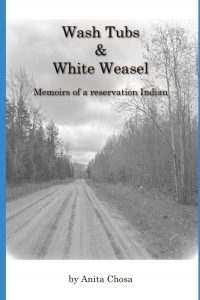 Anita Chosa’s memoir Wash Tubs & White Weasel: Memoirs of a reservation Indian, 1940-1960 discusses what life was like when she was a child and young woman in Beartown, a small community of eight families that was funded by the US Government and part of the larger L’Anse reservation. It was a short-lived community, but a special place, as Anita reveals.
The book’s title is based on the nicknames of Anita (Wash Tubs) and her best friend growing up, Sharon (White Weasel, a name Anita’s grandfather gave her because of her white hair). While Anita and almost everyone else in the community was Native American, Sharon was a White girl from Chicago who visited her grandmother each summer. Her grandmother lived in a large house in the area. Despite their different backgrounds, they became best friends. The last quarter of the book describes their friendship.
Most of the book’s earlier sections are devoted to different family members. Anita was part of a large, extended Ojibwe family. She had numerous aunts and uncles on both sides of the family, as well as siblings and cousins. Her mother’s parents stand out the most in these stories, but I enjoyed the stories about all of her family members. Anita wrote the book initially for her children and grandchildren, not thinking other people would be interested, but I personally believe this book is a valuable historical document about a time and place that no longer exist.
A large part of the book is devoted to what it was like to be Ojibwe in the mid-twentieth century. Anita explains that her family had intermarried with the French and the Finns over the years, so they were not pure-blooded and their French features were prominent, but they identified most as Native Americans regardless.
Life on the reservation wasn’t easy. They were poor. They didn’t have electricity. Beartown—named for the numerous bears in the vicinity—was three miles back in the woods and hardly anyone had a vehicle so they mostly walked. Those on the Keweenaw Bay Indian Reservation did not have hunting and fishing rights, but they ignored the rules, thinking how stupid the White man’s laws were when you had to feed your family. There was a lot of drinking which often resulted in violence toward each other. Anita does not shy away from any of these difficulties, but she had a magical childhood regardless.
Anita and her siblings indulged in playing games, including a game of make-believe. Today, she believes they became immersed in their fictional world as a way to escape from the adult world they couldn’t understand and that didn’t always understand them. At the same time, Anita recognizes the wisdom of her elders and their kindness. Her first crush was on one of her uncles. But of all her family members, my favorite stories she shares concern her maternal grandfather, who was born in 1864. She describes how he had never seen a movie, so she and some of the other grandchildren took him to one. They hadn’t thought twice about the fact that it was a John Wayne film. Grandpa loudly began telling the Native Americans in the film to “get him!” The rest of the audience who knew Grandpa started to cheer on the Native Americans with him. Anita states that when the movie ended, it was probably the only time John Wayne was booed in a theatre when the Indians lost.
Another great story about Grandpa is when an anthropologist visited the reservation. Grandpa told him all kinds of ridiculous things. When other family members later told him those things would end up in a book, he didn’t care. He said the White men had everything else so he wasn’t going to give them the old Ojibwe stories, which were all they had left. Years later, after Grandpa had died, Anita found a recording of songs of Indians from the Great Lakes. It included two with her grandpa singing; it was a wonderful gift to hear his voice again.
Other family stories depict the whole family going to the Yellow Dog Plains for several days to pick blueberries, a tragic fire in which a child was lost, family suicides and marriages, and why Anita even decided to enter a convent when she turned eighteen—a short-lived experience before she went to Chicago and began a career.
I thoroughly enjoyed reading Wash Tubs & White Weasel. I think this is a book that should live for generations to come as an important document about life on the L’Anse reservation at the time. I also loved that Anita and many of her family members retired to the reservation, which shows the closeness they feel to it. Anita, however, notes that despite the hardships and poverty of her earlier life, so much has been lost from that period—the sense of family and neighborly closeness and the importance of elders.
If this Wash Tubs & White Weasel: Memoirs of a reservation Indian, 1940-1960 is lacking in anything, it is family tree charts that would have made it easier to understand how Anita was related to everyone else in the book. I also think the back cover needs a description so the reader has a better sense of what the book is about, but for this reader, the subtitle alone was enough to make me want to read it. I am glad I did, and I will recommend it to friends, including those I know who grew up on the L’Anse reservation or in the L’Anse area. It’s an invaluable piece of Ojibwe and U.P. history.
Wash Tubs & White Weasel: Memoirs of a reservation Indian, 1940-1960
By Anita Chosa
ISBN: 979-8282915785
Anita M. Chosa
Release date 2025, paperback