Reviewer: Sharon Brunner
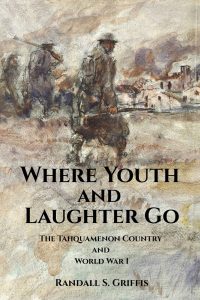
Randall S. Griffis’s book Where Youth and Laughter Go: The Tahquamenon Country and World War I offers a heart-wrenching rendition of World War I and some encounters of men from the Tahquamenon Country who fought in the war. Tahquamenon Country encompasses the small town of Soo Junction, Curtis, Germfask, Seney, McMillan, and Newberry and also extends towards Lake Superior, where it ends in the area of Paradise and Grand Marais. All towns and areas located in the Upper Peninsula of Michigan (U.P.). The men fought in battles in France and the border of Germany and other parts of Europe for the most part in this story. Some of the main characters were a pilot named Quinlan, Lieutenant Koepfgen, Ahola and other soldiers. World War I lasted from 2014 to 2018. The war occurred during Woodrow Wilson’s term, and the U.S. initially did not want to participate. This was a time of booming industrialization and Newberry was doing its best to be a part of the new prosperity with its mills, factories, and businesses. Before the war, the soldiers worked at a variety of enterprises such as the Charcoal Iron Company, local railroads, and Newberry State Hospital. Most of the men wanted to serve their country; however, they realized the war was filled with ever-present struggles and fear.
One of the main themes of this book was war fatigue. The men asked the question when do we eat, and there were struggles with mud, lice, and filth. They had to cope with the constant presence of the smells of death and battle. They often did not recognize the names of villages they passed through, and wished each day the war would end. The Germans posed as American soldiers and would climb into foxholes with American soldiers and murder them. Sometimes the American soldiers felt outnumbered and thought the only way to beat the Germans in one area was to bomb a whole forest area. Ahola’s life was ended when he was hit with a mustard bomb on the head. He died immediately. I learned that mustard gas and other poisonous gases were used by both sides in the conflict.
The poisonous gases were used since 1915, which added to the misery of the men fighting on the front lines. Chlorine was the first to be used, which caused violent retching and coughing. Tissue damage often causes permanent scarring. Phosgene was colorless, odorless, and disrupted the lungs’ ability to transfer oxygen into the bloodstream. The most widely used gas was mustard gas. It had a blister agent, and when a soldier inhaled the gas, his eyes swelled shut, causing temporary blindness and followed by the blistering and bleeding of the lungs. Sometimes soldiers would have to walk through areas where mustard gas was released.
As far as this story relates to my life, my father fought in the Korean War. My father-in-law fought in WWII. He told me what it was like to wait in foxholes. The terror of being shot at by the enemy. This book focused on men from the U.P. who fought in WWI. I have lived in the U.P. for my entire life. Because of this book, I learned a lot about WWI. I read a book a while ago about the sinking of the Lusitania by a German U-boat on May 7, 1915, killing 1,200 people, 128 were Americans. That incident altered the way the American public felt about Germany. I read in this book about howthe peasants in France who were so happy that the Americans came to help their country. They killed rabbits and chickens and threw a feast for the soldiers. I was glad the U.S. came to their aid.
The movie that came to mind was the 2022 “All Quiet on the Western Front” movie directed by Edward Berger. It was a German anti-war film based on Erich Maria Remarque’s novel, which depicted a young German soldier’s experience in WWI trenches. The movie stars Felix Kammerer as Paul Baumer, who replicated the initial patriotic fervor while the soldiers faced the horrors of trench warfare. The movie won multiple Academy Awards, including Best International Feature Film. One of the books that came to mind was “A World Undone: The Story of the Great War, 1914 to 1918” by G. J. Meyer. The book was a comprehensive history of WWI, which was praised for its accessible, holistic approach that covered all fronts and phases of the war from the assassination of Archduke Franz Ferdinand to the Treaty of Versailles. It was published in 2006 and provided a strong starting point for the general introduction of the conflict. Another book worth noting was “Michigan War Dead: Buried Overseas or Missing in WWI, WWII and Other Conflicts” by James N. Jackson published September 25, 2022. The information about the remains of American war dead at permanent overseas American military cemeteries was made by the American Graves Registration Service, Quartermaster General of the War Department. When the internment program was completed, the cemeteries were turned over to the American Battle Monuments Commission for maintenance and administration. This book provided the last name, first name, middle initial, rank, branch, unit, death date (either plot row grave or missing) and awards. The book could serve as a commemorative collection for the families of the deceased.
I recommend Where Youth and Laughter Go: The Tahquamenon Country and World War I for its historically accurate information about WWI, because of its heartfelt renditions of the hardships faced by the soldiers, for its account of a school superintendent who became a bomber pilot, and for its information about the two young war brides who left France to live in the U.P. Girffis provided a lot of detailed information about specific battles fought in WWI and what the soldiers were forced to endure such as surprise attacks by the enemy and the horrible environment set forth by the trench warfare. The young school superintendent was highly intelligent, someone who became bored with all the A’s he obtained in school so he thought he would shake things up by enlisting in the service. He carried out successful bombing escapades and some of his comrades met their demise as a result of Germany’s flight preparedness. Relationships between American soldiers and French women were frowned upon, and they were encouraged to remember the girls they left behind in the U.S. Griffis mentioned a French woman and her struggle to get her passport and a one-way ticket to the U.S. to join her husband. She arrived six months after her husband returned to the U.S. French women were considered inferior to American women. Griffis brought to life the trials and tribulations of some of the soldiers who traveled from the Tahquamenon Country to fight in WWI and how some lost their lives.
Title: Where Youth and Laughter Go: The Tahquamenon Country and World War I
Author: Randall S. Griffis