Review by Mack Hassler
“…In the beginning was the Word, and the Word was with God and the Word was God.” Fourth Gospel, by Saint John, 1:1
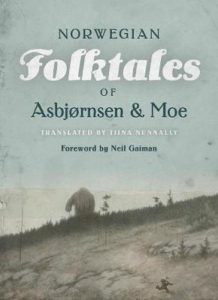 I have reviewed several beautifully designed and large hardcover volumes by Minnesota. This time, they sent me a paper edition of this 2019 imprint Norwegian Folktales of Asbjørnsen and Moe. We had a review posted here on May 1, 2021 of that edition, which included a Foreword by Neil Gaiman who is a well-known writer of Fantasy and science fiction living in Minnesota. Gaiman loves these tales. In place of the Gaiman Foreword, this printing of Nunnally’s work includes a lot more front matter that she translates about her own work as a translator, as well as about the two young men in the old days who did the original collection of the tales; and Nunnally translates their own Introductions and other front matter. Thus I feel this new printing of her work ought to be reviewed here again. Once again, I am impressed by the book design and cover art: Theodore Kittelsen “Palace Shimmered Like Gold (1900). Tiina Nunnally herself is a well-known translator whose award-winning work I have been familiar with. The two original collectors and editors are Peter Christen Asbjørnsen (1812-1885) and Jorgen Moe (1813-1882)
I know that Nunnally knows this oral tradition for which the “storytellers” love and protect so jealously that to get interviews with them requires real diplomacy. Nunnally claims that speaking with the storytellers is necessary because they make small changes often in each telling. From my epigraph above, one can see that the stories themselves remind me of the Hebrew writers who followed and knew Jesus and who need to convince their readers who he was. The original collections in the Norwegian were done by the two young men lovers of the old tales, whom I mentioned above and required several introductions and Forewords to set the context for their listening and gathering. Nunnally translates all that apparatus from the several editions for us to better understand the work. Clearly, I read these prose explanations in the Asbjørnsen and Moe Forewords as similar to the many attempts we read in the work of the early Christians to explain exactly who Jesus was and how he fit into God’s creation. The first Gospel by Matthew that begins this work of the early Christians traces the lineage through sexual reproduction back carefully to the House of David among the early Hebrew Kings. But we knew there were differences and special differences in this gifted teacher who could heal. The mountain type experience reported by several of his followers where he appeared with Elijah and in all of the angelic splendor of his white robes as truly “the son of God” (often called “The Transfiguration – see Luke chapter 9) is more abstract than Matthew’s genealogy. Jesus himself told those with him to forget that they had seen this and to go down from the mountain top to be “with my people.”
In other words, both the explanations in the Bible as well as the explanations about the oral tradition of folktales suggest some mysterious origins. I think most great storytelling even back to Homer is, indeed, mysterious and meant to explain who we are in God’s creation. Further, I believe it is driven by what Coleridge called “The Primary Imagination” or God’s creativeness. I believe that so much of creation going back to Genesis is blown into life by the hot breath of God’s Word, going back to the Gospel of John. We were a desert people and we learned to listen when the burning bush speaks. The Angelic language was the original language and all of us, including the animals, could understand.
Nunnally opens her book with a great “Translator’s Note” (dated April 2019). And it should be read. She was born a Finn. Her Christian name is spelled with one of those double letters (Tiina) that make Finnish sound almost like the original Angelic Language. When my wife and I lived in the UP among the many Finns, they would laugh at us when we tried to pronounce that element of the language. We are clearly “fallen” human beings who speak more like barking dogs or snarling wolves than like Angels So I think as a Finn, Nunnally is uniquely hard-wired in her brain for the profession of Translator that she has mastered.
This book of hers is not only a beautiful work of book making, so characteristic of what the University of Minnesota Press usually publishes, but it also contains valuable ideas about how we ought to think about the creation of our humanity and about what can be done when the oral traditions of storytelling are understood in the culture of the Northwood Forests. I am delighted to have my copy. With her opening note on her translating and with the materials from the original collectors, this book is now much more valuable, I think, than the earlier edition that Gaiman praises as an anticipation of the modern market for and art of Fantasy. More valuable for us as “storytellers”
Norwegian Folktales of Asbjørnsen and Moe, translated by Tiina Nunnally (University of Minnesota Press, Minneapolis MN 55401, 2019), 319 pages, pbk, $29.95.