Review by Sharon Brunner
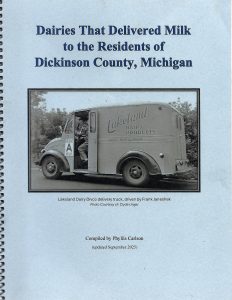 Phyllis Carlson’s “Dairies That Delivered Milk to the Residents of Dickinson County, Michigan” introduced a number of dairies that were in operation in the aforementioned county from the late 1800s to the 1970s during a time when lumbering and mining served as prevalent sources of income. Dickinson County was part of the Upper Peninsula of Michigan (U.P.). Milk was delivered by sleighs in the winter, and by oxen and horse-drawn wagons during the warmer months. The residents and businesses kept milk cold by the utilization of ice. Dairy farms, also known as wholesale operations, produced bulk milk for processors. The processors manufactured cheese, butter, and ice cream. Carlson’s research revealed many different types of dairy items and a vast amount of information about the dairies of the Dickinson County area.
Two of the themes were the collection of dairy memorabilia and the growth of dairy businesses. Throughout the book, Carlson provided actual pictures of glass bottles and caps, primarily from the 1920s. Many of the dairies took pride in their business names, so they had their names printed on bottles and caps. Carlson managed to collect a variety of them. Others who could not afford to put their names on bottles ordered their bottles from the Sears and Roebuck catalog. Pasteurization became a requirement in Michigan in 1947, and some of the dairy businesses could not afford pasteurization machines, so they either sold their operations or produced bulk milk for sale to processors. A “one man, one cow” dairy business often expanded to a much larger operation.
The book brought back happy memories of my childhood when I visited my grandparents’ farm. They had milking cows, pigs, and a large garden. I remember being amazed when I learned where milk came from. Carlson brought to life in her book the people who ran milk businesses, all their successes and trials and tribulations. This book sparked my interest in the dairy industry, and as a result, I contacted Bells’ Dairy and Hay Business in Sault Ste. Marie, Michigan. The man who answered the phone told me they closed the dairy part of the business in 2018, costs outweighed the profit. They sold their 220 cows to an operation with three to four thousand cows. Their family’s business had 80 cows when he was growing up and they grew to 220 cows when he was older. And now their business serves as a haying business. They provided hay to local farmers. He told me about a dairy business in Skandia, Michigan (south of Marquette, Michigan) that use robots to milk their cows. I wonder how the cows feel about that.
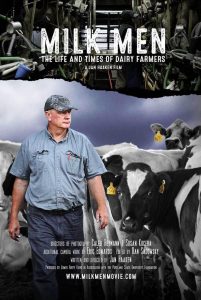 The movie that came to mind when reading this book was Milkmen: the Life and Times of Dairy Farmers, a 2015 documentary. The movie explored the global dynamics of dairy farming concerning small and medium sized dairies. The surviving farmers confront pressures to increase their production. The book that came to mind was Keeping a Family Cow: The Complete Guide for Home-Scale, Holistic Dairy Producers, 3rd Edition. That book described how the cow was a productive creature. Because of them humans can have fresh milk, cream, butter, cheese and ice cream. Cows can turn a profit and provide for human health.
I recommend this book for its extensive information about dairy farms located near and in Dickinson County, Michigan, because of its detailed information about the owners of said dairies, for its assorted collection of dairy memorabilia and for its historical data that described the growth and hardships of the dairy industry in the western portion of the U.P. A portion of the U.P. that sported a history of lumbering and mining. One father worked in the mines and decided he wanted a better life for his sons, so he started a dairy business. He only saw the sun on Sundays. The miners fought his position as a dairy farmer and destroyed some of his dairy stock. He put up a good fight and won. As stated earlier, the state of Michigan required the pasteurization process in 1947 and dairies that could afford the pasteurization equipment survived. Some switched to bulk milk production or they had to sell their businesses. In this book, some of the operations were sold to other businesses and Carlson gave the names of said operations. Carlson provided a vast amount of information from her extensive amount of research since the 1970s and her efforts need to be commended. Her interest in the dairy business started out as a hobby that blossomed. She provided an interesting view of the dairy business, many of the people who made it happen, and how the milk was delivered in Dickinson, County, Michigan.
Title: Dairies That Delivered Milk to the Residents of Dickinson County, Michigan
Author: Phyllis Carlson